

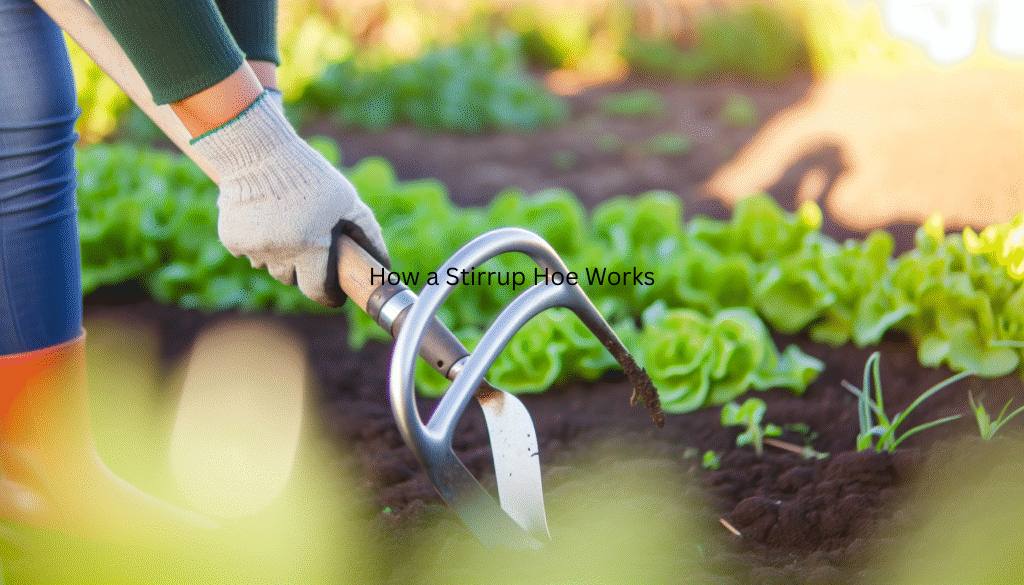
The stirrup hoe (also called hoop, oscillating or hula hoe) is a scuffle tool that slices weeds just below the soil surface with a looped double-edge blade. This article explains how it works, which weeds and conditions it suits best, step-by-step technique, selection and maintenance, and how to combine it with other organic strategies to reduce weeding time and protect soil health.
How a Stirrup Hoe Works
The stirrup hoe, sometimes called a hoop hoe or oscillating hoe, is distinguished by its open, rectangular or loop-shaped blade that forms a double-edged stirrup mounted perpendicular to a long handle. This loop blade may be fixed rigidly or attached with a hinge mechanism, allowing it to oscillate front to back as you push and pull. When in use, the blade glides just below the soil surface, slicing through weeds at their stems and shallow roots in both directions. The sharp edges shear weed growth with minimal resistance, creating a smooth, quick action that is ideal for repeated passes.
Scuffle hoes vs. draw hoes
Garden hoes generally fall into two categories: scuffle hoes and draw hoes. Scuffle hoes, such as the stirrup, hoop, and oscillating hoes, are designed to work in a push-pull motion, keeping the blade close to the soil surface. This scuffling action disturbs only the top few centimeters, which is crucial: most weed seeds germinate and sprout near the surface, so shallow cultivation effectively severs their stems and disrupts young root systems before they can establish deeply. In contrast, draw hoes (e.g., the standard garden hoe) are pulled toward the user in a hacking or chopping motion, tending to penetrate deeper and causing more soil disturbance, which can bring new weed seeds to the surface and disrupt soil structure.
Name variants and design
The tool is sold under several names: stirrup hoe, hoop hoe, oscillating hoe, hula hoe, loop hoe, and action hoe. The fixed-loop version is rigid, offering more control for heavier soils, while oscillating or hinged models pivot to maximize contact and reduce friction as the blade moves forward and back. Blade width varies (commonly from 3″ to 7″), and both straight and slightly serrated edges can be found.
Advantages:
- Fast, efficient removal of small seedlings and annual weeds
- Minimal disturbance to soil structure and beneficial organisms
- Works equally well pushing and pulling
- Reduces strain by allowing upright posture
Limitations:
- Less effective against deep-rooted perennials or woody weeds
- Performance declines in heavy, sticky, or rocky soils
- Needs sharpness and correct depth for best results
The stirrup hoe is the optimal choice whenever you need rapid, shallow cultivation of young weeds, particularly in well-prepared vegetable beds and on loose, fertile soils.
Best conditions and weeds to target
Optimal Soil Conditions
- Light to medium-textured soils are best suited for stirrup hoe use. These soils provide just enough resistance for the blade to slice through weeds without binding or clogging. A loose, workable tilth in the top few centimetres allows the blade to skim smoothly just below the surface.
- Aim for conditions where the soil is neither muddy nor extremely hard. If the ground is soggy, heavy clay, or thick with thatch, the blade can quickly gum up—reducing efficiency and making cleanup more time consuming. Likewise, on rocky or compacted terrains, maneuvering is challenging and the tool’s action can be blocked.
- With very dry, crusted soils, it’s harder to achieve good contact, so shallow annuals may escape. A light pre-irrigation or working after a gentle rain may help in these cases, as long as the soil dries enough to avoid sticking to the blade.
Moisture Considerations
- If the soil feels sticky or clumps when pressed, it’s likely too wet and the stirrup hoe may clog quickly.
- If it’s so dry that your blade barely penetrates or simply scrapes dust, efficiency drops. Slightly damp but crumbly soil is generally ideal for smooth scuffling.
Weeds Best Targeted
- The stirrup hoe excels at rapidly severing small weed seedlings and shallow-rooted annuals before they toughen or set seed.
- It’s highly effective against grass seedlings, chickweed, lambsquarters, small crabgrass, and pigweed at the seedling stage. These weeds’ roots cluster just beneath the surface, allowing the blade to cut them with minimal effort.
- However, the tool is less effective on taprooted or deep-rooted perennials (like dandelion, dock), woody stems, or species that resprout from deep below (such as field bindweed). In these cases, only the tops are removed, and regrowth is likely.
Frequency and Timing Recommendations
- Scuffle with the stirrup hoe weekly or every other week during periods of active weed germination or following rain or irrigation.
- Early Spring: Target pre-emergence or right as weed cotyledons appear.
- Late Spring–Summer: Continue with biweekly sessions to prevent seedlings from establishing.
- Late Summer/Fall: Use for late flushes or site cleanup post-harvest.
The stirrup hoe is at its best skimming through loose soil to swiftly cut young, shallow-rooted weeds before they gain a foothold, providing low-effort, high-impact weed control when used early and often.
Technique and ergonomics for efficient weeding
- Posture and Safety:
- Stand tall with your feet shoulder-width apart and knees softly bent, keeping your back straight rather than hunched. This distributes force evenly and helps prevent back strain.
- Grip the handle lightly but firmly with both hands—one near the end for leverage, and the other about midway down for control. Shift hands as needed for reach and comfort.
- Wear sturdy, closed-toe shoes or boots for protection from debris and accidental contact. Gloves are recommended to shield your hands from blisters and splinters—choose ones that allow a good grip on the handle.
- Stay alert as you work near tender seedlings or close rows—keep the blade facing away from stems and double-check your spacing before each stroke.
- Approach your row standing nearly parallel to the area you’ll weed, so the blade can skim just beneath the soil crust.
- Set the blade angle at a shallow rake—tilt it so only the bottom edge makes contact, minimizing disturbance.
- Maintain shallow depth control—the blade should slice just beneath the surface (about 1–2 cm deep is ideal) so roots are severed without turning up new weed seeds.
- Push and pull with a smooth, fluid motion. The stirrup shape enables a natural back-and-forth rhythm—push forward to slice, pull back to sever residues.
- Find your rhythm and pace—move slowly at first to maintain accuracy, then settle into a gentle rocking pattern. There’s no need for forceful chopping: let the blade do the work.
- Use medium-length strokes (about 30–60 cm per sweep). The coverage should overlap slightly with each pass to ensure thorough weed control.
- Repeat passes, moving steadily along the row and overlapping edges by a few centimeters for complete coverage. Finished areas should show disturbed surface, not upturned soil.
- Working near desirable plants:
- Angle the blade away from stems and roots of crops—work the outside edge of the stirrup near sensitive plants.
- Use short, controlled strokes in tight spots to avoid slips.
- Always work from the outside-in towards plants, not directly at them.
- Switch to a hand weeder or pull weeds by hand if you’re within 2–3 cm of delicate seedlings.
- Common mistakes and how to avoid them:
- Pushing too deep—lighten pressure and decrease blade angle.
- Turning up large chunks of soil—use a shallower stroke and keep the blade nearly horizontal.
- Attempting tough, woody weeds—cut these at the surface and remove them by hand or with a stronger tool.
- Working too fast in crowded beds—slow down near valuables to prevent accidental damage.
- Mini troubleshooting:
- Blade clogs with mud—wait for drier conditions or scrape off soil as you go.
- Bent blade—pause and gently straighten; check regularly for damage.
- Missing tiny seedlings—go back over the area at a perpendicular angle for missed weeds.
- Action tip: Practice your stirrup hoeing for a few minutes each visit, listen to your body, and take breaks—efficiency comes with muscle memory and staying pain-free ensures you’ll enjoy weeding for years to come.
Choosing and caring for your stirrup hoe
- Blade material: Compare carbon steel (sharpens easily, durable but prone to rust if not oiled) with stainless steel (more weather resistant, needs less maintenance, but is harder to sharpen). Choose carbon steel if you want a razor edge and don’t mind extra care, or stainless for low-fuss reliability.
- Blade shape and width: Smaller, narrow hoops (3-5 inches) let you weed precisely between close rows or seedlings. Wider blades (6-7 inches) cover more ground quickly in open beds, but can crowd tight spaces.
- Fixed vs. oscillating/hinged: Fixed models are sturdy and simple. Oscillating designs flex slightly, keeping the blade flush with the soil for efficient cutting on both push and pull. Hinged versions adapt best to uneven ground, reducing wrist strain, but may require more frequent tightening.
- Handle length and material: Longer shafts (54–60″) help maintain a straight back, while mid-length handles offer more precision in raised beds. Wood is classic and gentle on hands but needs occasional oiling. Fiberglass resists weather and is light, aluminum is lightest but less forgiving under heavy load.
- Replaceable blades: Models with replaceable blades extend tool life and make quick work of maintenance, especially after damage or years of use.
- Grip ergonomics: Cushioned or contoured grips prevent blisters and boost control for longer sessions.
- Pros and cons at a glance:
- Carbon steel blade: +Pour sharpness, –Needs frequent oiling
- Stainless steel blade: +Rustproof, –Harder to sharpen
- Oscillating design: +Smooth action, –More moving parts
- Wood handle: +Classic feel, –Heavier, needs care
- Fiberglass handle: +Weatherproof, –Can be slippery
- Replaceable blade: +Long-term value, –Slightly higher cost
- Pros and cons at a glance:
- Budget and longevity: Less expensive stirrup hoes often use thinner metal, non-replaceable blades, and basic wood handles. These are suitable for light duty or small gardens. Investing in a professional-grade model pays off for larger plots: they stay sharper, resist bending, and often feature upgradeable parts, saving money and frustration over years.
- Maintenance steps:
- After each session, knock or rinse off soil and debris from blade and shaft.
- Wipe dry fully, then lightly oil metal parts to prevent rust (vegetable or mineral oil works).
- Scrape off sap/residue with a putty knife or coarse cloth.
- Check and tighten bolts, screws or hinge nuts as needed; replace any worn hardware.
- Store hanging or handle-up in a dry spot, never on the ground or in direct sun.
- Sharpening and blade replacement: Maintain a 30-degree bevel on the cutting edges with a fine file or whetstone, working away from your body. Sharpen when weeds start to tear instead of slice. Replace blades if pitted/rusted, cracked, or repeatedly dull. For swap-out: disconnect any fastenings, match new blade to old orientation, and resecure tightly.
- DIY/modification guidance: Add bicycle handlebar tape or foam pipe insulation for extra comfort (secure tightly to avoid slips). If handle is too long or short, cut wood/fiberglass with a fine saw and finish edges smooth. Stick to approved replacement blades; don’t improvise with unsafe metal. Always wear gloves and eye protection when modifying.
- Recommended: Clean after every use, oil metal weekly, and check fasteners monthly during heavy seasons for top performance and tool lifespan.
Fitting the stirrup hoe into an integrated weed management plan
Integrated weed management means leveraging multiple methods to maintain healthy, productive beds—because no one tool, including the stirrup hoe, solves all weed problems alone. While the stirrup hoe excels at speedy removal of small, surface weeds, weeds of varying ages, types, and locations call for a broader strategy.
- Mulches: After prepping beds and using the stirrup hoe to slice out emerging weed seedlings, apply organic mulch such as straw or leaf mold. This suppresses future weed germination. Scuffle weekly with the stirrup hoe between mulch renewals to maintain a clean surface.
- Hand-pulling: For established perennial weeds with deep taproots or tough runners (e.g., dandelion, bindweed), combine weekly hoeing with targeted hand-pulling. Use the stirrup hoe for small, annual weeds; reserve hand-weeding for stubborn survivors.
- Crop rotations: Rotate crops seasonally to interrupt weed life cycles. The stirrup hoe is invaluable when establishing new crops—use it before planting each crop and between rows during early root establishment.
- Cover crops: Between main crops or at end of season, sow dense cover crops (like clover or rye) to outcompete weeds. Use the stirrup hoe to manage seedlings before sowing, then let cover crops shade out future weeds naturally.
- Targeted spot treatments: In high-pressure areas, combine shallow hoeing with spot application of organic treatments or flame weeding, always attempting physical removal with the stirrup hoe before escalating.
- Early spring: Scuffle weed seedlings as soon as soil can be worked, then mulch exposed areas.
- Mid-spring to summer: Hoe once a week, especially after rains. Refresh mulch and hand-pull deep-rooted weeds missed by the stirrup hoe.
- Late summer: Use hoe for late flushes, then remove weed seed heads before they mature.
- Fall: Sow cover crops as summer crops finish; limit hoeing, relying on cover crop shading.
- Work shallowly with the stirrup hoe to avoid bringing buried weed seeds to the surface—most germinate only when exposed to light.
- Remove weed seed heads rather than chopping mature weeds into beds, as this limits future weed seed rain.
- Minimize disturbance around crops to preserve soil structure and beneficial organisms. Shallow scuffling with the stirrup hoe supports thriving microbes and worm populations.
Safety/environmental note: Excessive digging or deep disturbance increases erosion risk and harms soil life. The stirrup hoe’s shallow action efficiently removes weeds while leaving the majority of soil undisturbed, supporting long-term fertility and ecosystem health.
- Scuffle with the stirrup hoe weekly for new seedling control.
- Refresh mulch after each hoeing pass to prevent future weeds.
- Hand-pull perennial weeds as soon as they appear.
- Remove seed heads before hoeing if weeds have matured.
- Sow cover crops in fall to suppress winter weeds.
Conclusions
The stirrup hoe is a fast, low-impact tool ideal for controlling young, shallow-rooted weeds while preserving soil structure. Mastering shallow scuffling, choosing the right model and performing simple maintenance makes weeding quicker and less strenuous. Use the stirrup hoe alongside mulches, hand-weeding and cultural controls for durable, sustainable reduction of weed pressure in vegetable beds and ornamental borders.

[…] The hula hoe is a simple, highly effective scuffle hoe for routine weeding, offering speed and minimal soil disturbance when used correctly. Choose a model with appropriate blade style and a comfortable handle, maintain it with regular cleaning and light oiling, and buy from a retailer after comparing specs and reviews. With proper technique and care your hula hoe will keep beds tidy for years. […]
Love this summary—hula (stirrup) hoes really are one of the fastest ways to stay on top of weeds with minimal soil disturbance when you use that smooth push‑pull motion. Thanks for sharing our stirrup hoe guide