

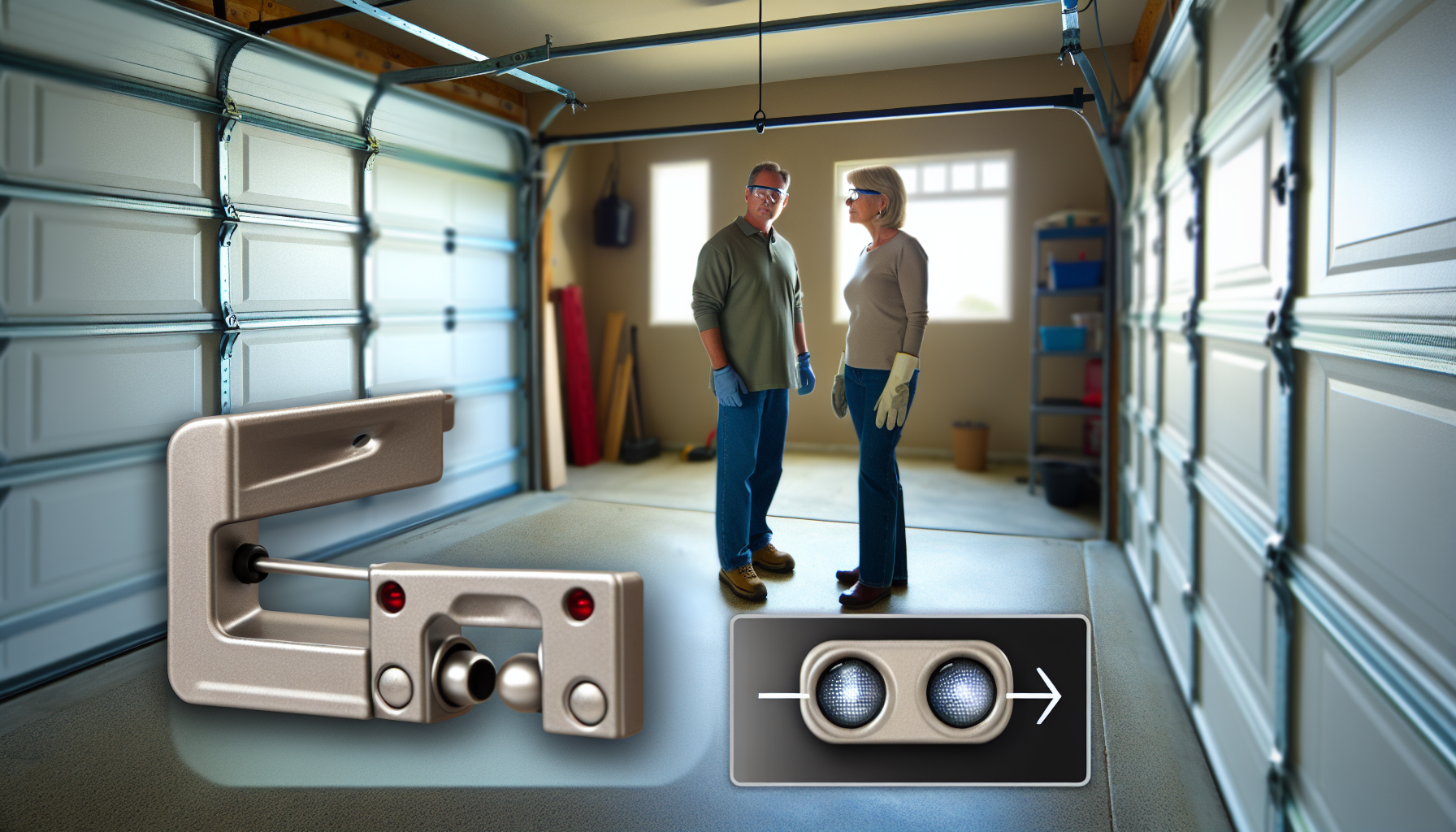
This Garage Door Alignment and Sensor Aiming Guide explains how to properly adjust tracks, rollers, and door hardware while accurately calibrating photoelectric sensors. Learn step-by-step alignment methods, measurement tolerances, troubleshooting tips, and safety practices to ensure smooth and reliable operation.
Why proper alignment matteWhy the Garage Door Alignment and Sensor Aiming Guide Is Essential for Proper Door Functionrs for garage doors
Door alignment means ensuring all mechanical elements—garage door tracks, rollers, hinges, and springs—are positioned correctly so the door travels smoothly and evenly. Garage door sensor alignment refers specifically to the correct aiming of photoelectric safety sensors, usually installed at the base of the tracks, whose beam path must be precisely directed so the system can accurately detect obstructions when closing.
- Safety:
- A misaligned door or sensors can defeat essential safety features. An off-track door may bind or collapse, while misaligned photo-eyes may fail to stop the door from closing on a child, pet, or object, presenting a significant hazard.
- Performance and reliability:
- Poor alignment leads to binding tracks, uneven rollers, and excess resistance. This causes the opener to work harder, increasing strain, shortening motor life, and risking premature component failure.
- Component wear and energy loss:
- Continuous misalignment accelerates wear on rollers, bearings, hinges, and springs. Gaps from improper alignment can cause air leaks, raising heating and cooling costs and reducing weather seal effectiveness.
Recognizing alignment issues early can save on costly repairs. Look for these realistic warning signs:
- Uneven daylight gaps along the door edges
- Door movement that is jerky, noisy, or rough
- Door that rubs, sticks, or hesitates, especially near the floor or header
- Automatic opener reverses unexpectedly during travel or won’t fully close
- Blinking or steadily lit red/yellow LED indicators on sensor housings (each manufacturer uses different LED codes, always check your manual)
Regulatory and safety context: Residential garage door systems are subject to standards such as UL 325, which mandates safety reverse systems (photo-eyes or edge sensors) for openers. Many local building codes also specify safe installation practices, including required beam height and sensor spacing. Always verify the latest requirements on reputable sources such as Wikipedia’s “UL 325” page or your local building code website to ensure full compliance.
The use of a door alignment tool and careful focus on garage door sensor alignment is not just a matter of convenience—it is essential for safe, energy-efficient, and durable garage door operation. Ignoring these steps can have legal, financial, and personal safety consequences.
Types of door alignment tools and choosing the right one
- Straightedge and Level:Simple and essential, this classic garage door alignment tool includes a long straightedge (usually aluminum or steel) and a bubble level. It’s ideal for checking track and panel straightness.
- Pros: Inexpensive, widely available, easy to use, no batteries.
- Cons: Accuracy depends on tool quality and user skill; can be awkward for double doors or tall openings.
- Laser Alignment Gauges:Laser track aligners project a precise beam, making parallelism checks fast for tracks and hinges, and aligning sensor beam paths easier.
- Pros: High accuracy, works over long distances, easy to see errors.
- Cons: Moderate to high cost, requires batteries, learn to handle sensitivity to bumps or dust.
- Track Gauges:Pre-set metal or plastic tools that fit between tracks to set spacing, commonly used for quick garage door installations or repairs.
- Pros: Fast and repeatable; good for standard doors.
- Cons: May not fit non-standard or commercial tracks, only verifies spacing—not plumb.
- Feeler Gauges:Used to check gap consistency around the door and between track rollers and the track edge.
- Pros: Inexpensive, great for tuning optimal clearances.
- Cons: Only for gap checks, not for large structural alignment.
- Dial Indicators:Highly precise gauges for detecting minute shifts. Used mostly in advanced or commercial repairs.
- Pros: Extremely precise for measuring track or panel runout.
- Cons: Costly, may be overkill for residential doors, more skill required.
- Plumb Bob:Gravity-based vertical checker, ideal for ensuring tracks are truly vertical (‘plumb’).
- Pros: No batteries or calibration needed; reliable and basic.
- Cons: Slower, affected by air movement, challenging in tight spaces.
- Socket/Torque Tools:Precision sockets with torque settings prevent overtightening or undertightening track bolts or hinges, ensuring alignment is held without hardware damage.
- Pros: Essential for secure and consistent hardware tightening.
- Cons: Less important for actual measuring, but critical for lasting results.
- Digital Angle Meters:Use electronics to provide accurate track and hinge angles, key for modern insulated or heavy doors.
- Pros: Instant angle readings, easy repeatability.
- Cons: Mid-to-high price, requires batteries and careful handling.
- Specialized Sensor Alignment Tools:
- Small Bubble Levels: Clip or magnetic types give fast sensor mounting checks. Cheap, simple, but be aware of cheap ones losing calibration.
- Laser Pointers: Attach to the sensor bracket for automatic ‘beam tracing.’ Quick and visual, but ensure true alignment of the tool itself.
- Temporary Target Reflectors: Place at one sensor to visually confirm perfect beam path from its partner.
- LED Indicators: Some sensors and third-party sensor alignment tools offer built-in LEDs to confirm live beam detection. Fastest confirmation, but always double-check against physical alignment.
- Choosing the Right Tool:
- Budget: Household repairs may be fine with a sturdy level or straightedge, while professionals or those with double, high-lift, or insulated garage doors may benefit from laser track aligners or digital meters.
- Project Scope: Single-door garages may only need basics; commercial or heavy-paneled doors justify investment in precise, digital, or custom-fit equipment.
- Skill Level: Beginners benefit from preset gauges and visual sensors, while pros leverage dial indicators, torque tools, and advanced electronic tools for fine tolerance adjustment.
- Accuracy Expectations:
- Aim for tracks to be perfectly plumb (vertical within 1/8″ over 6 feet is a useful tolerance), and both sides parallel (no ‘toe-in’ or ‘toe-out’). For sensors, usually within 1/4” horizontally, and the beam height within 6” of the floor—check your manufacturer’s manual for exact ratings.
- Practical tip: If your straightedge or level is accurate, and the door or sensors operate without error or blinking lights, your alignment is likely within safe, reliable bounds. Always verify with current manufacturer documents for your specific model.
- Buying and Rental Tips:
- Laser alignment tools, digital angles, and track gauges can often be borrowed from major hardware stores or rental centers. For one-time jobs, consider renting high-end tools instead of buying.
- Maintain tools: Wipe off dust, store in dry places, and periodically check levels and digital meters for calibration. Replace batteries as needed. A small investment in proper storage extends tool life and accuracy.
- PPE: Always wear work gloves and safety glasses (especially around moving doors or when striking tools). For torsion springs or overhead work, a hard hat and non-slip shoes are also recommended.
Essential Garage Door Alignment Checklist:
- Straightedge or Laser Track Aligner
- Bubble Level or Digital Angle Meter
- Socket/Torque Tools for hardware
- Basic PPE (gloves, glasses)
- Sensor Alignment Tool (bubble level or laser pointer)
- Track Gauge or Feeler Gauge (as needed)
- Reference (manual/spec sheet for your garage door)
Preparing for alignment and a safety checklist
- Step-by-step Preparation Before Using Garage Door Alignment Tools or Adjusting Sensors:
- Power down and disconnect:
Unplug the garage door opener and use the wall switch to cut off power at the breaker if possible. This prevents motor activation and protects you during work near sensors or track components. - Physically secure the door:
Lower the door fully, then attach C-clamps or locking pliers below the bottom rollers on both tracks. This stops the door from moving during alignment or garage door sensor adjustment. Never rely solely on the opener to keep the door stable. - Mark reference points:
Use masking tape or a pencil to mark track positions, hinge locations, and current sensor alignment. This makes it easier to compare before and after, for precise garage door alignment tool use.
- Power down and disconnect:
- Inspection Items (Visual and Physical Checks):
- Check torsion and extension springs for gaps, rust, or damage (spring replacement or adjustment is strictly professional work).
- Inspect cables for frays or slack and ensure cable drums are secure.
- Examine rollers for flat spots or stiffness. Spin them by hand to check for binding.
- Look at hinges and brackets for cracks or loose fasteners.
- Confirm tracks are straight and not bent or loose, and verify garage door sensor brackets are firmly mounted.
- Inspect sensor wires for cuts, nicks, or loose connections, and check opener carriage for abnormal play or noise.
- Electrical Safety Essentials:
- Always isolate power at the outlet or breaker before opening covers or handling garage door sensor wiring.
- Handle low-voltage sensor wiring with care; wires for photo eyes typically carry 12–24V. Use a voltage tester to double-check—never assume wires are cold.
- Verify wiring diagrams and voltage specs in your specific opener’s manual before connecting, disconnecting, or testing sensor circuits.
- Worksite Setup for Safety and Efficiency:
- Set up bright, stable lighting to illuminate work on both the door and tracks.
- Position a sturdy ladder—a step ladder for sensors and a taller ladder for track adjustments. Place it on level ground and never overreach.
- Wear gloves to protect from sharp metal and eye protection against debris.
- Have a helper when moving or supporting a heavy door, or when checking spring tension (never remove or wind springs without a certified technician).
- Record Pre-alignment Measurements and Create a Log:
- Measure and note the door’s full height, gap width on both sides (between door and track), sensor height above floor, and horizontal offset between sensors.
- Create a simple log on paper or your phone to document these “before” specs, aiding in accurate comparisons after adjustment.
Printable Safety Checklist for Garage Door Alignment and Sensor Aiming
- Unplug opener and shut off power at breaker
- Lock door in place with C-clamps/locking pliers
- Put on gloves and eye protection
- Inspect springs, cables, rollers, and track (call a pro for repairs)
- Check sensor mounts and wiring
- Set up stable ladder and lighting
- Mark reference points on tracks and sensor brackets
- Log pre-alignment measurements
- Have a helper for heavy/awkward adjustments
- Never attempt spring replacement or major cable repair unless qualified
Spring repair, cable replacement, and major tension adjustments are strictly the job of trained professionals – do not attempt these tasks.
Step by step door alignment and sensor aiming procedure
- Aligning Tracks and Rollers
- Tools needed: Socket set, screwdrivers, door alignment tool or laser gauge, straightedge, level, wrenches.
- Loosen track fasteners at the brackets using a socket or wrench. Do not remove the bolts; just loosen them enough to allow slight movement of the tracks.
- With the door fully closed, use a straightedge or a laser gauge to check vertical track alignment. Both right and left tracks must be plumb (straight up and down) and parallel to each other.
- Adjust brackets at the wall or ceiling mounts as needed to align tracks. The distance between tracks should be consistent and just wider than the door thickness, allowing rollers to move smoothly without excessive play or friction.
- Tighten all fasteners after adjustments, then check door travel by lifting the door manually to mid-height and fully open. Watch for binding, uneven gaps, or scraping. Repeat alignment if necessary at multiple positions.
- Caution: If tracks are bent or excessive force is required, do not attempt to reshape or hammer tracks—consult a professional.
- Testing Door Tension and Balance
- With the opener disconnected, gently lift the door to waist height and release.
- If the door remains in place, tension is adequate. If it rises or drops rapidly, springs may be imbalanced.
- Caution: Do not adjust torsion or extension springs yourself—call a trained technician for spring service.
- Check for noisy operation or jerky movement, which can indicate roller wear or moisture.
- Aligning Garage Door Safety Sensors
- Recommended height: Sensors should be 4–6 inches above the finished floor, mounted using brackets provided by the manufacturer.
- Ensure both sensor faces are clear of dirt or debris and lenses are undamaged.
- Loosen sensor mounting wingnuts. Using a laser pointer or temp indicator, adjust each lens so they are pointing directly at one another—align within 2–3 degrees horizontally.
- Observe indicator LEDs: a solid light means proper alignment, while a blinking light indicates misalignment or obstruction.
- If needed, shim or adjust bracket height for beam centering. Once aligned, retighten wingnuts firmly.
- If LED still blinks, check wiring for pinches or breaks and confirm the power is restored to the opener.
- Testing Door and Sensor Operation
- Remove locking clamps and reconnect power. Manually test the door for smooth open/close action.
- Operate the door via remote. Place a solid obstruction (such as a 2×4 piece of lumber) in the sensor’s path and attempt to close—door should immediately reverse upon detecting the object.
- Repeat with sensors blocked and unblocked to verify proper reversal and sensor operation.
- Sample issue: If the door closes with obstruction present, stop and recheck alignment and sensor wiring before further use.
- Electrical and Continuity Checks
- With power off, inspect sensor and wall control wires for damage—replace if necessary.
- Use a multimeter to check for continuity along the sensor circuit. Verify correct polarity per manufacturer’s diagrams.
- If sensors are not receiving power (no LEDs), confirm transformer and fuse status or replace opener batteries if applicable.
- Caution: If in doubt about wiring, always refer to opener documentation or seek professional assistance to avoid electrical hazards.
Troubleshooting maintenance and when to call a professional
Common Symptoms and Likely Causes
- Sensors obstructed or miswired: Door won’t close or randomly reverses. Check for items, dust, or spider webs blocking the safety beams.
- Dirty sensor lenses: Dull or blinking sensor LEDs. Dust, paint splatter, or condensation can obscure the lens, interrupting beam alignment.
- Loose sensor mounts: Beam shifts due to vibration, leading to misalignment.
- Bent tracks or worn rollers: Noisy, jerky movement, audible scraping, or jamming.
- Misadjusted limit switches: Door doesn’t fully open or close, or reverses too soon.
- Weak opener motor: Door struggles to move, opens incompletely, or moves more slowly than usual.
- Spring issues: Door feels unbalanced or is difficult to lift manually. Never attempt spring repair yourself—call a professional.
Stepwise Diagnostics for Each Symptom
- Sensor beam test: Check that sensor LEDs are solid (not blinking). Break the beam with an object—the door should not close.
- Continuity test: Use a multimeter to confirm wires from sensors to opener have continuity, particularly if both LEDs are off.
- LED diagnostic meanings: Refer to manufacturer guide. Some use green for ‘power’, amber for ‘aligned’; blinking suggests misalignment or wiring issues.
- Temporarily swap sensors if in doubt about a faulty one, watching if the problem follows the sensor or the wire run.
- Hand-operate the door (with opener disconnected) to spot points of excessive drag, binding, or track misalignment.
Maintenance Schedule Recommendations
- Monthly: Visual check for debris, frayed cables, or sensor misalignment. Clean sensor lenses with a soft, dry cloth.
- Semi-annual: Lubricate rollers and hinges, tighten all bolts (door alignment tool maintenance), check tracks for obstructions.
- Annually: Hire a pro for a safety check—especially for spring tension and opener settings.
When to Call a Professional
- Broken springs, spring adjustments, or cable issues—these are high-risk.
- Severe track or panel damage needing realignment or replacement.
- Openers with complex logic boards, coded error lights, or persistent electrical faults.
- Repeated sensor failures despite correct alignment and wiring.
Cost and Time Expectation, Technician Selection Tips
- Sensor re-alignment or replacement: $75–$200 (1–2 hours).
- Track realignment: $100–$300 depending on severity (2–3 hours).
- Spring replacement: $150–$400 (professional only).
- Choose a technician with licenses, insurance, written estimates, and verify compliance with safety standards.
Garage Door Sensor Alignment Troubleshooting and Maintenance Flowchart
- Check for obstructions & clean sensors.
- Visually inspect track alignment and rollers.
- Confirm sensor LEDs—realign if blinking.
- Test door balance (with caution); if unbalanced, call a pro.
- Test wiring using continuity; repair/replace if faulty.
- If symptoms persist, contact a qualified technician.
Conclusions
Accurate door alignment and properly aimed sensors restore safety and prolong garage door lifespan. Using the right door alignment tool, following safe step‑by‑step procedures, and performing routine checks prevents misalignment and sensor faults. If adjustments or repairs exceed your skill level, contact a licensed technician. Regular inspection, cleaning, and seasonal recalibration keep the system reliable and protect people and property.
